
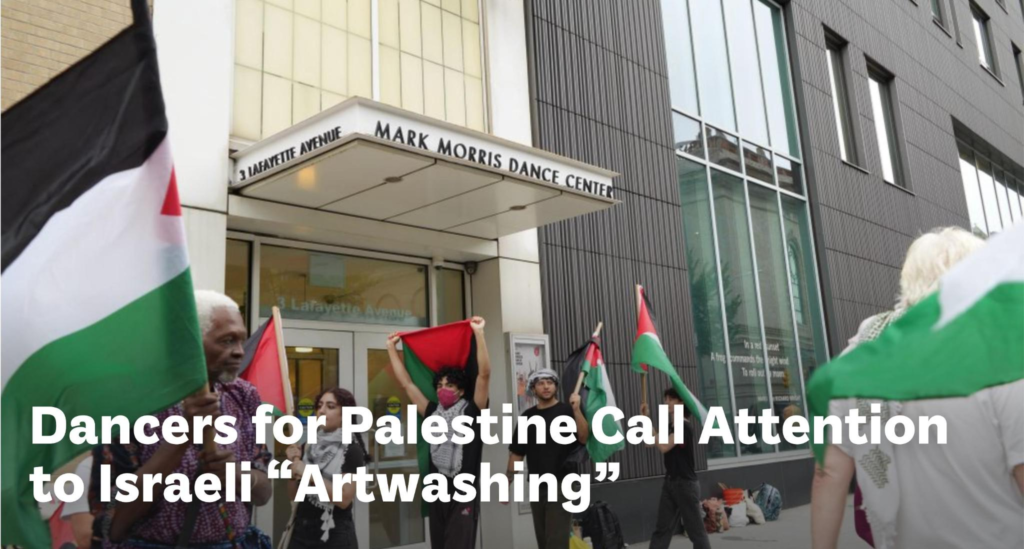
Demonstrators protest the Mark Morris Dance Center (Photo credit: Nuriel Vera-DeGraff).
Dancers for Palestine Call Attention to Israeli “Artwashing”
In cultural boycott effort, Palestine activists protest dance intensive affiliated with Israeli propaganda group at Brooklyn dance center
Nuriel Vera-DeGraff Aug 27
Chanting “dance dance for liberation, down down with occupation!,” more than two dozen demonstrators affiliated with the activist group Dancers for Palestine picketed outside the Mark Morris Dance Center in Brooklyn on August 5, protesting a dance intensive affiliated with a company that is part of a public relations campaign to improve Israel’s image abroad.
The for-profit organization Gaga Movement Ltd. — which runs the “GagaLab” intensive programs — is affiliated with the Batesheva Dance Company, a non-profit that is part of the propagandist “Brand Israel” campaign and receives politically conditioned funding from the Israeli government. Gaga Movement is a target of the Boycott, Divestment, and Sanctions movement, and Dancers for Palestine have demanded that Mark Morris cut ties with the company and have been picketing the twice-a-year GagaLab intensives since 2024, after their requests to meet were ignored by the dance center.
This is the fourth time Mark Morris is hosting the GagaLab intensive in their Brooklyn building, and the fourth time that Dancers for Palestine — a group of dancers who mobilize against cultural institutions with ties to Israel and amplify the goals of the Palestinian Campaign For The Academic and Cultural Boycott of Israel — have picketed in front of the dance center.
The Mark Morris Dance Center did not respond to a request for comment from The Indypendent.
The Aug. 5 picket, which started in the afternoon and lasted for an hour, included a walking picket, speeches from organizers, and a lively dabke dance circle. While picketing, demonstrators repeated chants including “One, two, three, four, no more Gaga no more! Five, six, seven, eight, we will dance to liberate!” Demonstrators continued to walk and chant even as a heavy rain started to fall near the end of the picket.
One, two, three, four, no more Gaga no more! Five, six, seven, eight, we will dance to liberate!”
On August 9, around two dozen Dancers for Palestine members came back to picket again in front of Mark Morris. At the picket, demonstrators heard speeches from members of Artists Against Apartheid and Theater Workers for a Ceasefire and were joined by members of DJs Against Apartheid, Shut it Down for Palestine, and the Rude Mechanical Orchestra. In addition to a dabke dance circle choreographed by the El Funoun Popular Dance Troupe, demonstrators participated in a protest dance performance collaboratively choreographed by Dancers for Palestine.
Confronting Brand Israel
Dancers for Palestine organizers argue that the Betsheva Dance Group and Gaga Movement are “artwashing” Israel’s genocide in Gaza and its continued occupation of Palestinian land in the West Bank and East Jerusalem, which is illegal under international law. Artwashing refers to the practice of using artistic and cultural products to conceal, legitimize, or distract from a harmful activity. While often associated with gentrification, the BDS movement has often used the term to decry the Israeli government-run Brand Israel campaign’s use of Israeli culture to shift attention away from the actions of the Israeli government and improve its international image.
Manatsu Tanaka, a dancer, educator, artist, and organizer with Dancers for Palestine, noted that the Batsheva Dance Company is a central player in Brand Israel. “[Batsheva] has been called the ‘best known global ambassador of Israeli culture’ by the Israeli Ministry of Foreign Affairs,” Tanaka said. “[They’ve] been receiving government money to go on international tours, planting seeds of the impression that Israel thrives as a ‘progressive’ and ‘innovative’ contemporary cultural hub.”

While Gaga Movement is technically separate from Batsheva and does not receive funding from the Israeli government through Brand Israel, Tanaka maintains that it “has played a crucial role in expanding Batsheva’s fame through intensives and classes, often luring collegiate students into thinking that Tel Aviv is the place to study contemporary dance.”
Gaga, is the primary aesthetic and choreographical style used by the Bateshva Dance Company and was created by Ohad Naharin, the non-profit’s former artistic director.
Because of Gaga Movement’s connection to Batsheva and the Israeli government, Dancers for Palestine tried to meet with Mark Morris and demanded that the dance center cut ties with the company. After not hearing back, members of the activist group began picketing in front of the dance center during the GagaLab intensives.
Tanaka was satisfied with the Aug. 5 picket. “I personally had a good conversation with one of the GagaLab participants who stopped by and stood with us for a while. They wanted to know more about why Gaga Movement is complicit, since they wanted to support Palestine but had no idea about the connections between Gaga, Batsheva, and artwashing,” they said.
In protesting the GagaLab intensive, Dancers for Palestine organizers place themselves in a broader tradition of cultural boycotts. John King, a longtime BDS supporter and member of ACT-UAW Local 7902 (a union which represents part-time and adjunct professors, student educators, and healthcare workers at NYU and The New School), sees cultural boycotts as necessary because “all cultural work is political — where groups are getting funding, where they’re putting their emphasis, where they’re putting their silence.”
What a Cultural Boycott Can Do
King, a musician who is also a member of the Unite All Workers for Democracy caucus and UAW Labor for Palestine coalition within the UAW, added that cultural boycotts like the Wednesday picket seek to “raise awareness, be educational, and pull back the layers of propaganda that attempt to make it seem like the GagaLab intensive is about ‘just dancing.’”
Liz June, an organizer with Dancers for Palestine and Artists Against Apartheid, believes that artists are uniquely positioned to push social change because their role in cultural production allows them to highlight the contradictions of their lived experience.
June made the contradictions explicit: “Why are we told there’s no money for arts programming when our taxes are going to fund genocide? Why are so many performing artists in New York City hesitant to make a political stance for fear of losing work opportunities, especially when they contribute so much to the NYC economy?”
The pickets outside of Mark Morris aren’t the end of the story. “Dancers for Palestine will be back,” King said. “We will keep engaging with the Mark Morris Dance Center to have them end their complicity with the apartheid state. We will continue to be at demonstrations, and we will be steadfast and continue to fight for a free Palestine from the river to the sea.”


